Login

Payments
What Happens When AVS and CVV Run at Checkout?
AVS and CVV checks run in seconds at checkout to confirm the billing address and card security code match what the issuing bank has on file, helping catch fraud before a sale goes through while keeping legitimate customers moving.

Redde Payments
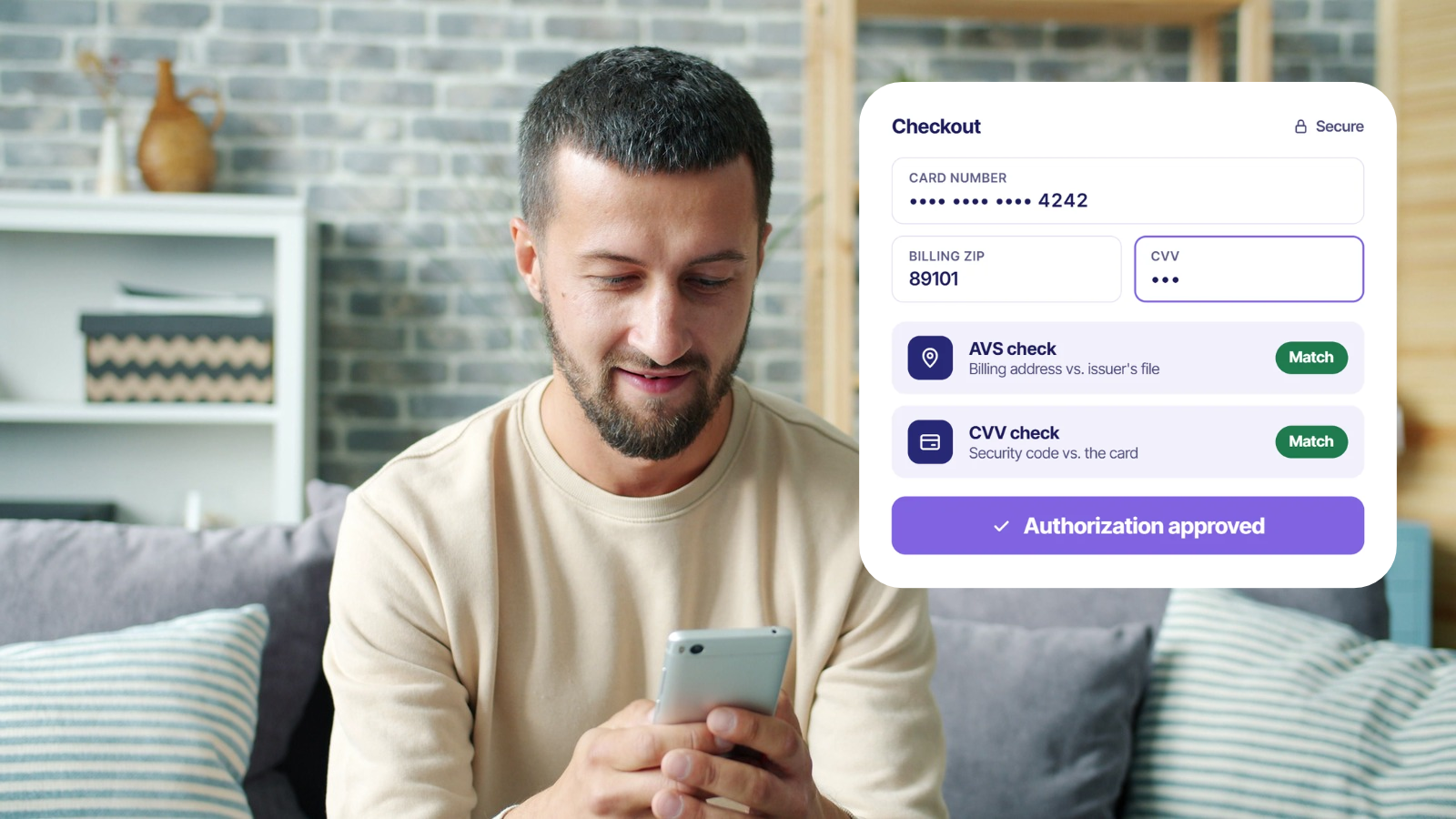
AVS and CVV are two quick checks that ask a customer’s issuing bank a simple question during a purchase. The responses give useful information but this doesn’t guarantee that an order is legitimate.
The holiday rush brings a wave of first time customers. You don’t know much about them, their name, their buying habits or even their home address. So when you open your payment settings or look at a transaction’s details, and see “AVS” and “CVV” staring back at you, it’s natural to wonder what they actually do.
Here’s a calm, real world explanation of both AVS and CVV, so when you read the results in your gateway you can understand them in confidence and set realistic expectations for your team.
AVS: “Does this address match what the bank has on file?”
AVS stands for Address Verification Service. When a customer types in a billing address, AVS compares their entered address to the billing address the card issuer has on file.
In most cases, AVS looks at two things: the number part of the address and the ZIP code. It doesn’t check the customer’s name, and it doesn’t check the shipping address.
The bank sends back a short result code that can mean one of the following:
- Full match: both the street number and the ZIP code match.
- Partial match: only the ZIP code, or only the street address number matches.
- No match: neither one matches
- Not available: the bank couldn’t check the match. This can be very common with cards that are issued outside of the US.
An AVS result is information provided to you by the issuer and it doesn’t affect whether the transaction is approved or declined. It is entirely up to you whether you decide to take the sale or not depending on the result of AVS. Your payment gateway has customizable settings to help your business decide whether you want to take the sale or decline it.
Good to know: A "Not available" result on an international card isn't a red flag by itself. AVS is mainly supported by card issuers in the US, Canada, and the UK, so many cards issued elsewhere simply can't be checked.
CVV: “Does this person have the card’s security code?”
CVV is the short security code printed on the credit/debit card: three digits on the back of most cards, or four digits on the front of American Express cards. You may also see it called CVV2, CVC or CID. They all mean the same thing.
When a customer enters that code at checkout, the issuing bank confirms whether it matches the card. The idea is simple, the code isn’t in the card’s magnetic stripe so entering it suggests the shopper has access to the card details rather than just a card number.
One helpful detail for your team: card network rules don’t allow businesses to store the CVV after a transaction is authorized in a customer vault by design. If a customer asks why they have to re-enter it on a later order, that's the reason.
Never write it down: Don't keep a customer's CVV anywhere after the sale. That includes order notes, spreadsheets, emails, sticky notes, and recorded phone calls. PCI DSS prohibits storing it after authorization, even if it's encrypted.
Neither verification completely validates the sale
AVS and CVV each answer one narrow question. Neither one can tell you who is actually placing the order, or whether the cardholder approved it.
A few reasons to keep expectations realistic:
- Matches can still come from the wrong person. If someone has a full set of card details, including the address and CVV, both checks can come back as a match.
- Mismatches can come from the right person. Real customers move, mistype a ZIP code, use an old address, or shop with a card issued abroad where AVS isn’t available.
- They only look at the payment details. Neither check looks at the shipping address, the order size, or anything about the customer’s behavior.
- They don’t settle chargebacks later. A matched CVV or AVS result doesn’t decide whether a customer can dispute a charge.
The best way to think about them: two small useful signals that sit alongside your own judgement.
Want a stronger check? 3-D Secure (you may see it as a Visa Secure or Mastercard Identity Check) goes a step further by asking the card issuer to confirm the actual cardholder before the same goes through.
Simple holiday habits that pair well with AVS and CVV
You don’t need a complicated process to use these checks well. A few everyday habits go a long way during the busy season:
- Know your settings: Find out how your account currently treats AVS and CVV results. CVV mismatches will always decline but you can adjust your AVS settings to decline or send for a manual review in the case there is a mismatch.
- Read the result, not just the approval. An approved transaction with an AVS mismatch is worth a second look, especially on a larger sale.
- Look at the whole order. Compare the billing and shipping details, the order size, and anything that seems out of character for your business.
- Reach out when something feels off. A quick, friendly email or call to a new customer is often the easiest way to clear things up.
- Keep good records. Save order details, shipping confirmations, and customer communications. Clear records make it easier to answer questions later.
- Brief your team. Make sure everyone who handles orders knows what AVS and CVV results mean and when to ask for help.
Holiday tip: If a customer disputes a charge, your records become your evidence. Visa's dispute guidelines for merchants lay out what documentation helps, so it's worth a skim.
The bottom line
AVS asks whether the address number matches. CVV asks whether the security code matches. Both are helpful pieces of information and both work best when paired with your business policies and gateway settings.
Want a hand understanding how AVS and CVV are set up on your account before the holiday rush? The Redde Payments team is happy to walk you through your settings and answer your questions. Ready to sign up with a provider that can help you get set up with a gateway that works your AVS and CVV results? Get started here.
References
1. PCI Security Standards Council. Can card verification codes be stored for card-on-file or recurring transactions? (FAQ 1280).
2. Adyen Docs. AVS checks (which regions’ issuers support AVS).
3. Visa. Visa Secure with EMV 3-D Secure.
4. Visa. What is 3D Secure and how does it work?.
5. Visa. Dispute Management Guidelines for Visa Merchants (PDF).
Get started with Redde
No matter what industry you're in, we make it easy to get approved and start processing. Competitive rates, fast setup, and a team that actually has your back. Our industry experts will walk you through every step of the way.