Login

Payments
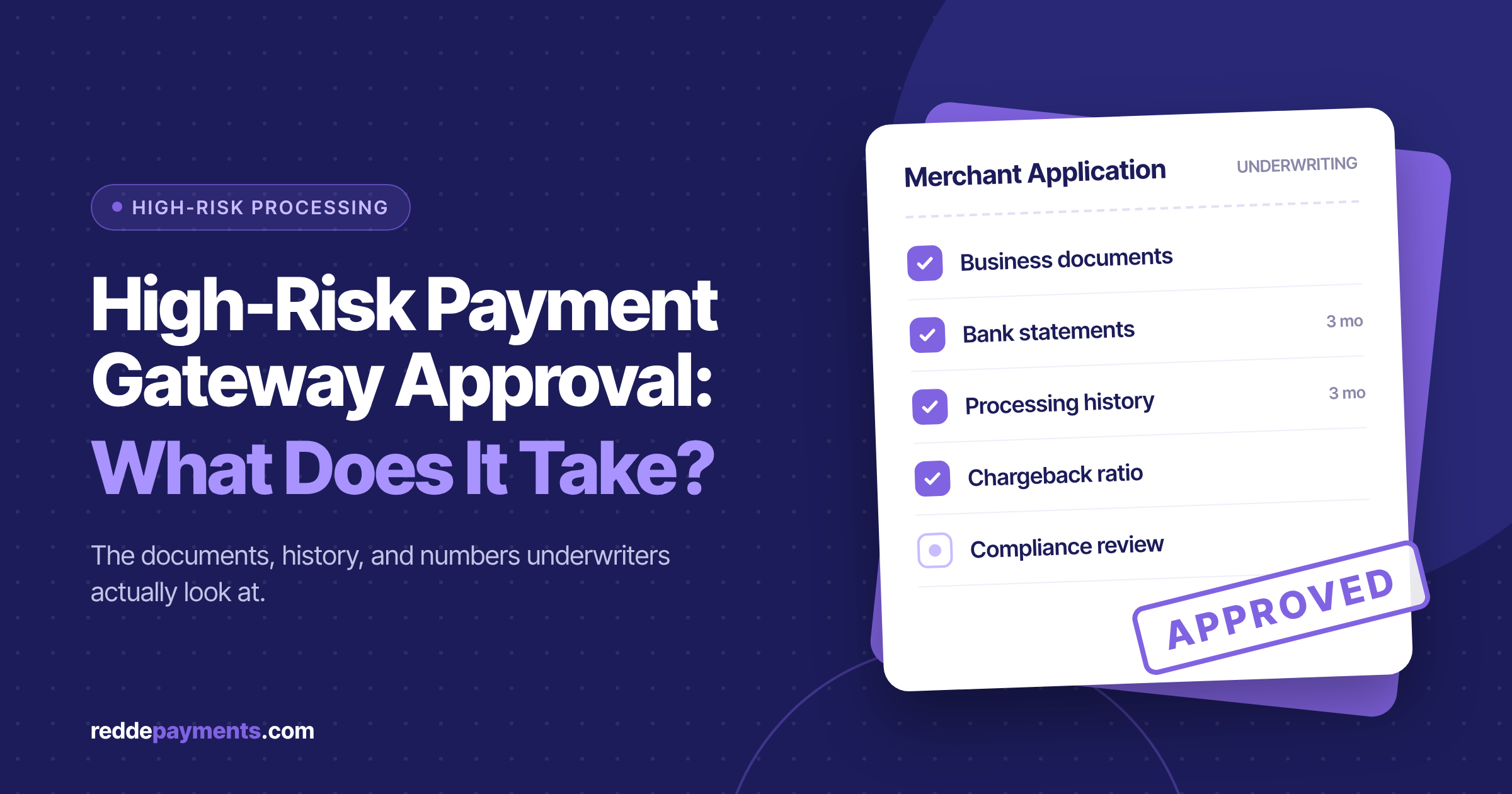
High-Risk Payment Gateway Approval: What Does It Take?
What underwriters check before approving a high-risk payment gateway, and how to get your application ready.

Redde Payments
High-Risk Payment Gateway Approval: What Does It Take?
Getting a high-risk merchant account approved comes down to two things: having a clean, complete application and working with a payment processor that actually understands your industry.
If you’ve been declined by Stripe, PayPal or Square, or had an account frozen without warning, you’re not alone. Most mainstream payment processors like the ones mentioned above are set up to accept lower-risk businesses. Everyone else that falls outside of this category needs a high-risk merchant account and a gateway that’s set up for it. This post walks through what underwriters check, which rules matter most, and how to put together an application that gets approved.
What makes a business “high-risk”?
A business is considered high-risk when a payment processor expects more chargebacks, more fraud or a higher level of regulatory due diligence. This is a classification, not a judgment on whether your business is legitimate or not.
Processors usually look at four things:
- Your industry: Industries that commonly require higher due diligence include CBD/hemp, nutraceuticals, subscriptions, travel, online gaming, adult, firearms, debt collection, credit repair and tobacco sales.
- How you sell: Invoicing, free trials, recurring billing, and long fulfillment windows all raise dispute risk.
- Your volume and ticket size: High monthly volume or large average tickets mean a bigger risk of losses if something goes wrong.
- Your history: A short operating history, poor personal credit, past account terminations or a MATCH listing against your business.
Good to know: High-risk is a classification, not a judgment. It reflects how processors price risk, not whether your business is legitimate.
What underwriters look for: the approval checklist
Underwriters want proof that your business is real, compliant and able to pay its own chargebacks in the event you receive them. A complete file is the single biggest factor in how fast you’re approved.
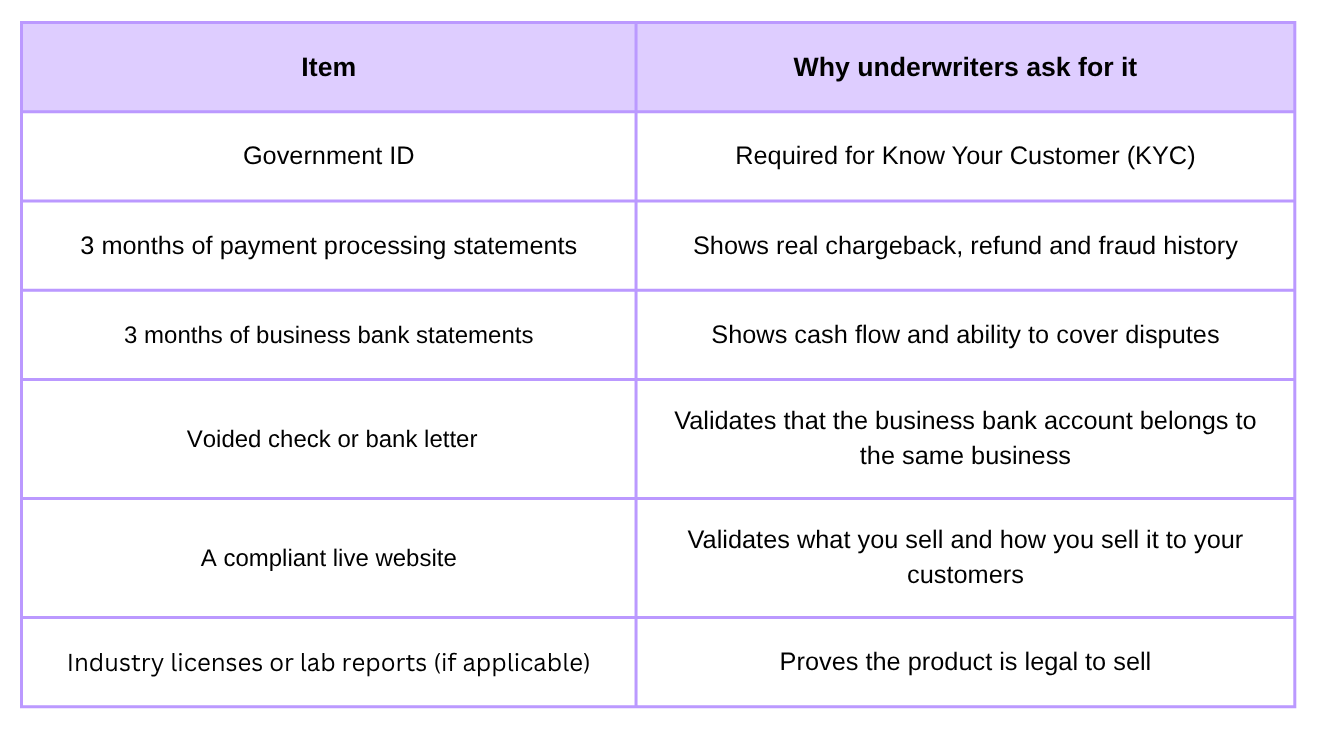
New businesses without processing history can still be approved. However, expect a reserve, a lower starting volume cap or both until you’ve built a track record.
Why high-risk applications get declined
Most declines come from fixable gaps, not from the industry itself:
- An incomplete or non-compliant website: Missing refund terms, hidden pricing or no customer service contact is the most common reason an otherwise good application gets stalled.
- Chargeback history not being presented during onboarding: Acquirers set their own internal limits, so a ratio that looks unmanageable to you can still be workable to them. Hiding processing history and coming in as a startup can actually hurt you more at times than showing your true history.
- A MATCH listing: Being on Mastercard’s terminated merchant file makes approval much harder, though some high-risk acquirers will still review the case.
- Mismatched information: A business name, address or owner that doesn’t match across documents triggers a fraud flag.
- Applying with the wrong provider: Many payment processors simply don’t underwrite certain verticals, so the application never had a chance.
How to improve your odds of approval
The merchants who get approved fastest show up prepared and show they can control disputes.
- Gather every document before you apply: A complete file can cut weeks off underwriting.
- Audit your website first: Make your refund policy, pricing, terms and contact details easy to find from every page.
- Use a clear billing descriptor: Customers who recognize the charge are far less likely to dispute it.
- Put fraud and dispute controls in place: 3D Secure, AVS/CVV checks, velocity limits and chargeback alerts all lower your ratio and show underwriters you’re serious.
- Be upfront about your history: Disclose past terminations or high chargeback months and explain what changed. Surprises found in underwriting kill deals.
- Plan for a reserve: Reserves are standard in high-risk processing. Expect a flat percentage of sales held either up to a set cap or until your account is re-reviewed.
Quick checklist: Complete documents, a compliant website, a clear billing descriptor, dispute controls in place, and full disclosure of your history.
Get approved with Redde Payments
Redde Payments specializes in high-risk payment gateway approvals, so you’re applying to a team that already understands your industry. We help you prepare a complete application and set you up with an expert who can get your account through compliance.
Typical approval times are within 1-2 business days. Check to see where your business industry falls within our guidelines: restricted businesses, prohibited businesses.
Ready to get started? Apply for a high-risk merchant account and a Redde specialist will review your file.
Sources:
Get started with Redde
No matter what industry you're in, we make it easy to get approved and start processing. Competitive rates, fast setup, and a team that actually has your back. Our industry experts will walk you through every step of the way.