Login
.png)
Payments
What Is Shop Pay?
What exactly is Shop Pay? We explain how Shopify’s one-tap checkout works and why it helps customers finish purchases faster.

Redde Payments

What Is Shop Pay? How It Works in 2026
Online shopping has never been more popular, but getting customers from “add to cart” to “order confirmed” is still one of the trickiest challenges in e-commerce. Studies from 2025 and 2026 consistently peg the global average cart abandonment rate somewhere between 70% and 78%, with some months pushing even higher. That means for every 10 shoppers who fill a cart, as many as 8 walk away without buying.
The reasons are familiar: surprise fees at checkout, a checkout flow that’s too long, or the dreaded “you must create an account” wall. These friction points cost merchants real money, which is exactly why tools like Shop Pay have become so valuable. Shop Pay tackles the checkout problem head-on with a streamlined, one-tap experience that keeps customers moving toward “buy.” Read on to explore what Shop Pay is, what’s new in 2026, and how to set it up for your store.
What Is Shop Pay?
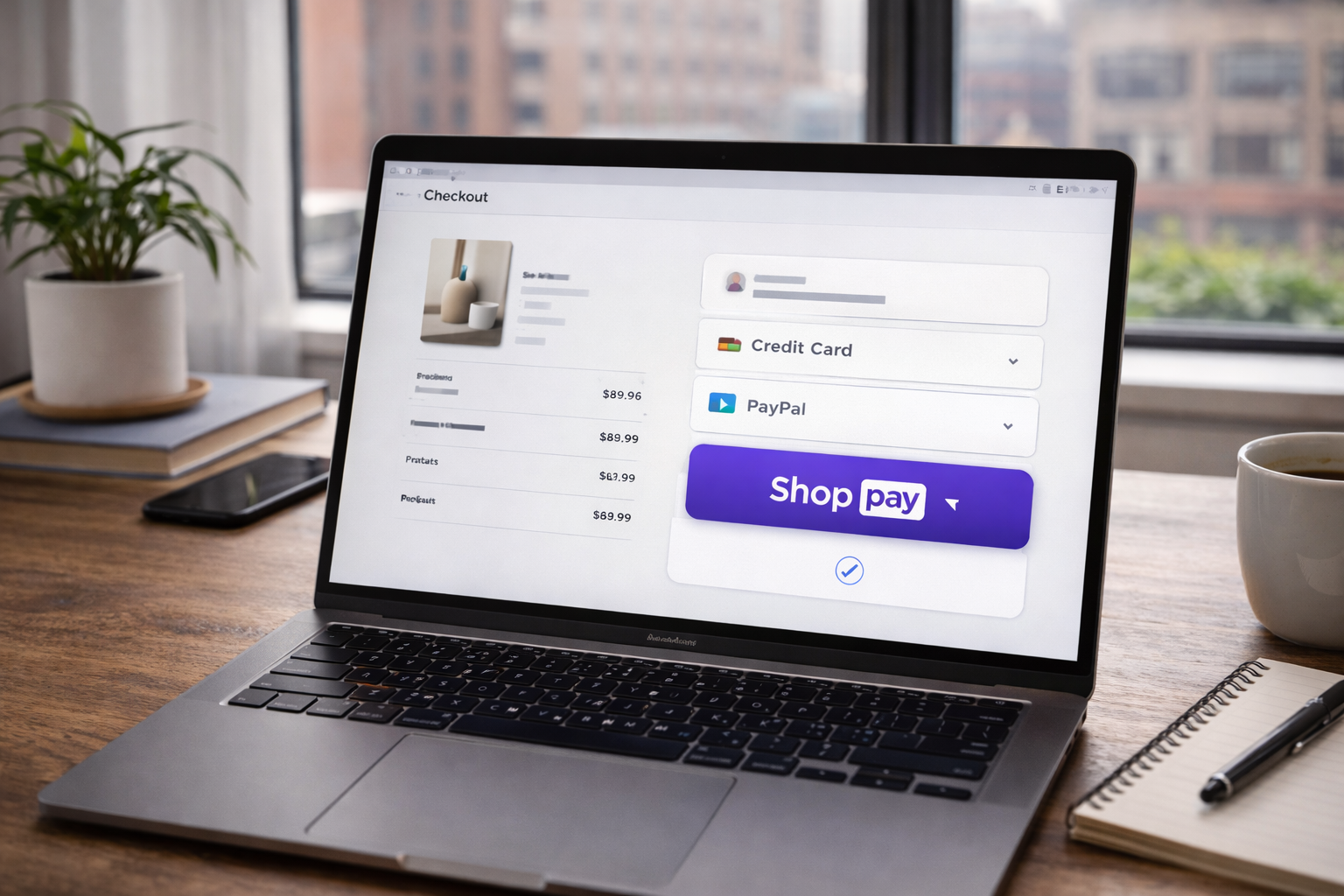
Shop Pay is Shopify’s accelerated checkout solution. It lets customers save their email, shipping details, and payment information, then breeze through future purchases with a single tap and a quick verification code. No re-entering card numbers, no hunting for the right shipping address. Just a fast, secure path to confirmation.
Since its launch, Shop Pay has grown into one of the most widely used checkout options in e-commerce. Over 2 million merchants now use it, and during the 2025 Black Friday and Cyber Monday weekend, Shop Pay processed nearly one-third of all orders across Shopify’s platform, up 39% year over year. That kind of adoption signals real confidence from both merchants and shoppers.
In 2025 and into 2026, Shopify has continued expanding what Shop Pay can do, adding cross-platform checkout support on Instagram, TikTok, and Google, deeper analytics inside the merchant dashboard, and expanded availability of Shop Pay Installments in new markets.
How Does Shop Pay Work?
Shop Pay is available to businesses using Shopify Payments, but merchants working with third-party payment processors can also offer it, making it accessible even for businesses in high-risk industries that rely on alternative providers like Redde Payments.
For Merchants
The Shop Pay merchant dashboard gives store owners a clear view of transactions, order activity, conversion rates tied specifically to Shop Pay, and how installment options are being used. Security is baked in at every layer: card data is encrypted and tokenized, and Shopify handles PCI compliance so merchants can focus on running their stores rather than managing security audits.
For Customers
Customers opt in by entering their email and payment details during their first checkout at any Shop Pay-enabled store. From there, Shop Pay securely saves that information. On every future visit, whether to that store or any other Shopify-powered store, their details are already there. Shopify reports that Shop Pay checkouts are up to four times faster than a standard guest checkout.
The Customer Checkout Process
About 21% of shoppers abandon their carts because the checkout is too complicated, and another 26% leave when they’re forced to create an account. Shop Pay removes both of those barriers. Here’s how the checkout flows:
- The customer selects Shop Pay at checkout.
- They enter their email or phone number to pull up their saved account.
- Their shipping address and payment details auto-fill, and they can select from any saved options.
- Shop Pay sends a six-digit verification code to confirm the purchase.
- The order is placed, and the customer can track it in real time through the Shop app.
The whole thing takes seconds, which is a huge deal when even a small improvement in checkout speed can move conversion numbers significantly.
Shop Pay Features and Benefits
Accelerated Checkout
Shop Pay’s core value is speed. By storing payment and shipping details, it turns a multi-step process into something closer to a single click. Shopify’s own data shows it can increase conversions by as much as 50% compared to guest checkout, and Baymard Institute research confirms that a large e-commerce site can see conversions improve by over 35% through better checkout design alone. Shop Pay is a major contributor to that kind of lift.
Buy Now, Pay Later (BNPL)
BNPL has gone mainstream. The Motley Fool Money’s 2025 BNPL Trends Study found that more than half of Gen Z and millennials now prefer BNPL over credit cards for purchases. Shop Pay Installments, powered by Affirm, lets merchants tap into that preference directly at checkout. For eligible orders, customers can split their total into four interest-free payments or opt for longer monthly financing on bigger purchases. One real-world example: Dr. Squatch saw average order value jump 60% for orders that went through Shop Pay Installments.
Enhanced Security
All Shop Pay transactions are encrypted and tokenized. Shopify maintains full PCI compliance and manages disputes and refunds, giving merchants a strong security foundation without the overhead of handling it themselves. As digital payment fraud grows more sophisticated in 2026, AI-powered fraud detection has also become standard in the background, flagging suspicious transactions before they become a problem.
Cross-Platform Reach
One of the bigger expansions in recent years is Shop Pay’s reach beyond Shopify storefronts. Customers can now complete Shop Pay checkouts directly on Instagram, TikTok, and Google, which means merchants can convert social media and search traffic without ever requiring a click back to their own site.
Marketing and Analytics
In 2025, Shopify integrated Shop Pay metrics directly into the merchant analytics dashboard. Merchants can now see conversion rates, average order values, and installment usage tied specifically to Shop Pay orders. The platform also supports personalized post-purchase messaging, shipping updates, and product recommendations, turning the checkout moment into an ongoing customer relationship.
Carbon-Neutral Shipping
Shop Pay contributes to carbon offset projects, including air capture and ocean-based carbon removal, for every order placed through the platform. For merchants with sustainability commitments, this is a straightforward way to offer customers something meaningful at no extra cost.
Shop Pay vs. Shopify Payments
These two are often confused, so here’s the quick distinction:
Shopify Payments is the payment processor, handling the actual transfer of money between a customer’s bank and the merchant. Shop Pay is the checkout experience layer, built for customers to speed up and simplify how they pay.
The good news is they work well together. Shop Pay is free for all merchants using Shopify Payments, and it’s also available to merchants using third-party processors. So you don’t have to choose one or the other; many merchants use both.
Shop Pay Installments: How It Works in 2026
Shop Pay Installments is powered by Affirm and gives customers flexible payment options for purchases of varying sizes. The structure as of 2026:
For orders between $50 and $999.99: Customers can split into four equal, interest-free payments due every two weeks. No fees, no impact on credit scores.
For orders between $150 and $20,000: Customers can choose monthly payment plans. These longer repayment terms are great for higher-ticket items, though monthly installments can affect a customer’s credit score if payments are missed.
Shop Pay Installments has continued expanding to new markets in 2025 and into 2026, making it available to more merchants internationally.
Shop Pay Alternatives
Shop Pay is a strong option, but it’s worth knowing what else is out there:
PayPal Checkout: One of the most recognized names in online payments globally. Customers can pay through their PayPal account or as a guest with a card, without sharing payment details with the merchant directly.
Klarna: A well-known BNPL player offering installment options, financing, and a “pay in 30 days” option popular in European markets.
Stripe: Highly customizable and developer-friendly, with support for a wide range of payment methods and the flexibility to build tailored checkout experiences.
Square: A solid fit for smaller businesses, with strong tools for in-person and online sales, invoicing, and inventory management.
Apple Pay and Google Pay: Digital wallets that allow one-touch checkout on mobile and desktop, with payment info stored securely on the user’s device. Both have seen strong adoption growth heading into 2026.
How to Set Up Shop Pay on Your Shopify Store
With Shopify Payments
- Log in to your Shopify admin panel.
- Go to Settings in the lower-left corner.
- Click Payment providers.
- If you haven’t already, activate Shopify Payments by following the setup prompts.
- Once Shopify Payments is active, Shop Pay is automatically enabled. Customize any checkout options as needed.
With a Third-Party Payment Gateway
- Check eligibility: Make sure your third-party gateway supports Shop Pay integration.
- Log in to your Shopify admin panel.
- Navigate to Settings > Payment Providers.
- Select your third-party gateway and follow that provider’s instructions for enabling Shop Pay.
- Look for the Shop Pay toggle during setup and enable it.
- Save your changes.
Setting Up Payments for High-Risk Merchants
For merchants in industries that standard processors don’t serve well, Shop Pay can still be part of your checkout stack through third-party gateways. Providers like Redde Payments specialize in high-risk categories and can integrate with Shop Pay while also offering fraud protection, chargeback management, and tailored payment plans that account for the specific challenges those businesses face.
Shop Pay FAQ
Does Shop Pay affect a customer’s credit score?
Shop Pay itself does not. It functions as a digital wallet and does not report to credit bureaus. However, monthly installment plans through Shop Pay Installments (powered by Affirm) can impact a credit score if payments are missed.
Is Shop Pay safe?
Yes. Shop Pay uses encryption and tokenization to protect customer payment data, and all transactions run through Shopify’s PCI-compliant infrastructure. No system is 100% risk-free, but Shop Pay has a strong track record on security.
Are there fees for merchants?
Shop Pay itself doesn’t carry a separate fee, but transaction fees apply through your payment processor. If you’re using Shopify Payments, those fees are determined by your Shopify plan. Third-party processor fees vary by provider.
What are the purchase limits for Shop Pay Installments?
Customers can use installments for purchases between $50 and $20,000. The exact terms depend on the merchant, the customer’s eligibility through Affirm, and the order total.
Where is Shop Pay available?
Shop Pay is available across Shopify’s supported markets, with ongoing expansion through 2025 and 2026. Installment features are currently focused on the US market, though Shopify has signaled plans to extend BNPL availability internationally.
Interested in optimizing your payment setup? Contact Redde Payments to explore solutions designed for your business type.
Get started with Redde
No matter what industry you're in, we make it easy to get approved and start processing. Competitive rates, fast setup, and a team that actually has your back. Our industry experts will walk you through every step of the way.



.png)