Login
.png)
Business
What New Small Business Owners Must Know to Build a Strong Brand
When branding fails to answer the one question that matters: "Why should I trust you?" you need a stronger brand reputation.

Derek Goodman

What New Small Business Owners Must Know to Build a Strong Brand
New small business owners often do the hard part, building a real product or service, then hit a frustrating wall: customers still hesitate because they don’t know what to expect. That hesitation is customer perception in action, and it’s shaped less by what’s “new” and more by what feels clear, consistent, and credible. Branding importance isn’t about looking polished for vanity; it’s about using brand identity to signal who the business is, what it stands for, and why it’s worth choosing. When that signal is strong, early business success gets easier.
What Branding Really Means (Beyond a Logo)
Branding is the total meaning people attach to your business after every touchpoint, not just your logo or colors. It’s how your brand elements, like voice, visuals, offers, and service, create a consistent expectation in someone’s mind. In plain terms, customer experience is the impression left by all those interactions, and branding is the system that shapes that impression.
This matters because people don’t just buy what you sell, they buy how confident you make them feel. When the experience doesn’t match the promise, trust drops fast and 52% of consumers stopped after a bad product experience.
Think of two coffee carts with similar drinks. One has clear signage, friendly script, tidy packaging, and the same vibe online and in person. The other feels random, even if the coffee is good, so customers hesitate. With the foundation clear, it becomes easier to build fast visuals that stay consistent everywhere.
Create On-Brand Visuals Faster With AI-Generated Image Workflows
Once you know your brand is the full experience, not just a logo, you can speed up how you deliver that experience visually. AI-generated images can help you create engaging visual content quickly for all of your business’s marketing needs, from social posts and email banners to website graphics and simple ads. Instead of starting from scratch every time, you can generate multiple image options in the same general style so your visuals stay recognizable across different channels while still giving you fresh variations. Using an AI art generator is especially helpful if you have a specific image in mind and need it fast, without graphic design experience.
Branding Approaches and Channels, Side by Side
A practical way to choose your next branding move is to compare how each approach reaches your target buyers, differentiates you from competitors, and supports clear positioning. This table helps you pick a “focus-first” lane, then expand once results and capacity improve. Teams that documented their strategy tend to report better outcomes, so treat your choice as a simple plan you can revisit.
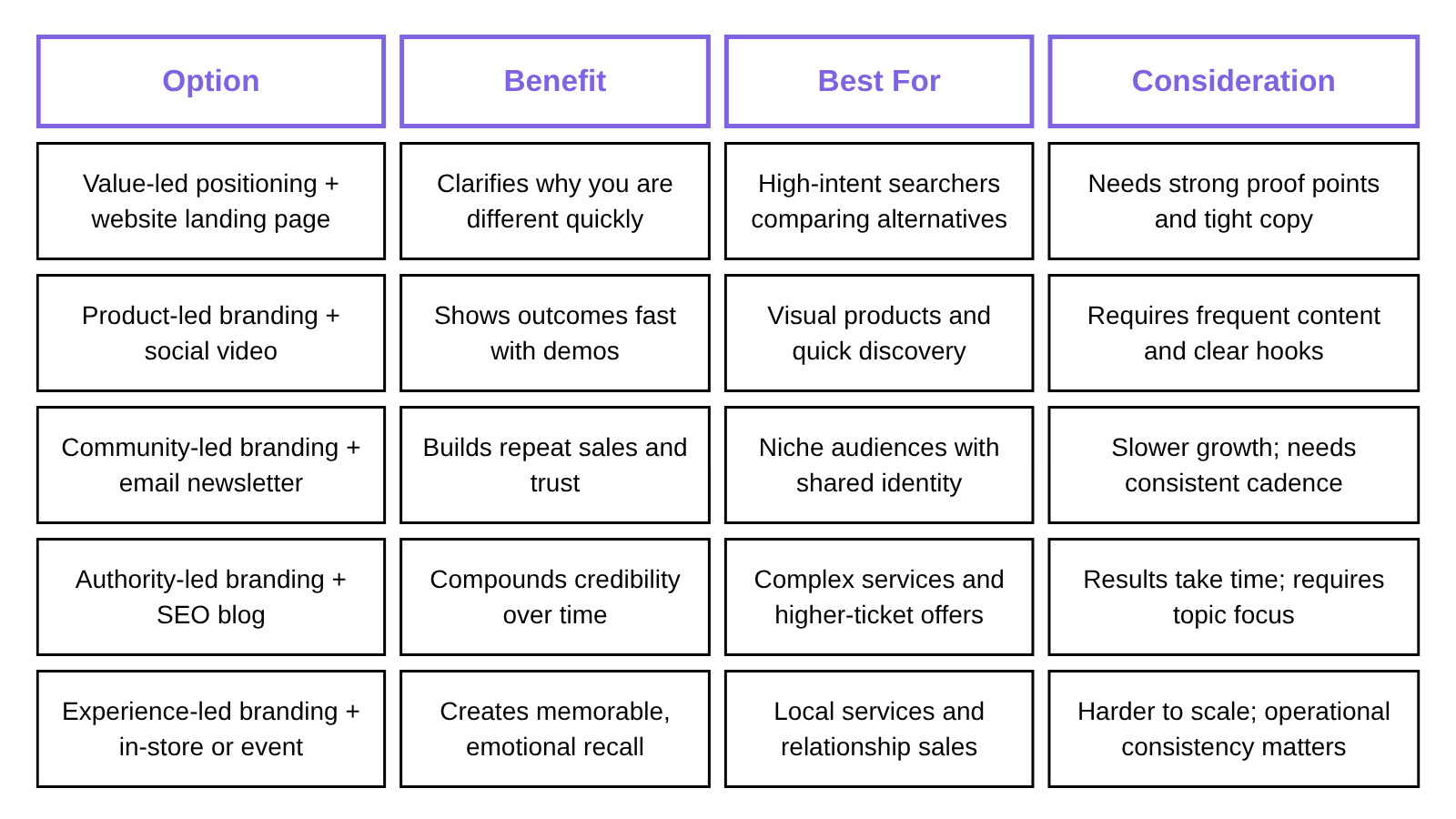
Use your competitive scan to pick what rivals under-deliver, then choose the channel where your target market already pays attention. Keep your positioning statement short, test one primary channel first, and add a second only when you can stay consistent. Knowing which option fits best makes your next move clear.
Build Consistency: A Voice-and-Execution Playbook
Consistency is what makes your brand feel “real” to customers, no matter which channel they find you on. Use these brand development steps to lock in a consistent brand voice, keep execution aligned, and choose smart DIY branding projects without overreaching.
- Write a one-page “voice snapshot”: Pick 3–5 voice traits (friendly, no-nonsense, premium, playful) and define each with a “do” and “don’t.” Add two sample lines you can reuse: a short bio and a standard product/service description. This works because it turns “brand vibe” into something you can actually apply when you’re writing a caption, a web headline, or an email.
- Choose your priority channels on purpose: Use the channel/approach comparison you already mapped to pick your “core three” touchpoints (for example: website, Instagram, and in-person script). Then decide what “good enough” looks like for the rest (a simple, consistent directory listing beats a neglected full profile). This keeps your messaging aligned where your target market actually pays attention.
- Build a message ladder (one promise, three proofs): Write one primary value promise (what you help people do) and list three proof points (how you do it, what makes it credible, what results people can expect). Turn those into repeatable phrases you can plug into different formats: a web hero line, a social caption, a 15-second intro. A consistent ladder prevents the “new angle every week” problem.
- Create a tiny brand kit you can hand to anyone (including future-you): Keep a shared folder with your logo files, 2–3 brand colors, 1–2 fonts, photo style examples, and 10 ready-to-use phrases (tagline options, CTA lines, customer-friendly explanations). Branding best practices lean on repeatability, one guide reduces random choices across your brand touch points, which supports a more cohesive experience.
- Do a “same offer, different channel” alignment check: Once a month, pick one core offer and rewrite it for three places: your homepage, a social post, and a sales conversation. Confirm the promise and pricing logic match, even if the wording changes. If you can’t keep it consistent in three formats, customers won’t either.
- DIY the low-risk projects; hire out the high-stakes ones: Safe DIY branding projects usually include writing your FAQs, refining service descriptions, choosing brand voice traits, and building simple templates. Consider professional branding services when a mistake gets expensive or hard to undo: naming, logo design, packaging, and website UX, especially if you’re entering a crowded market or investing in paid ads.
- Set one “consistency rule” and track it weekly: Pick a measurable rule like “every post uses our top promise + one proof” or “every invoice and email signature uses the same business name format.” Consistency compounds, research summarized by West Virginia University suggests brands with high consistency can see 10% or more revenue growth.
Build a Clear Brand This Week With One Consistent Change
Branding can feel like a moving target when every channel demands attention and every decision risks looking inconsistent. The steadier path is simple: choose focused branding strategies, commit to small business branding consistency, and treat brand implementation like a repeatable habit, not a one-time project. Do that, and customers start recognizing you faster, trusting you sooner, and responding more predictably, which makes customer engagement easier to read and act on. Consistency is the shortcut to trust when your budget is tight. Pick one brand improvement (voice, visuals, or promise), apply it across your top touchpoints for seven days, and note what changes in clicks, replies, referrals, or questions. Those small signals compound into clearer positioning, smarter decisions, and long-term brand growth.
Get started with Redde
No matter what industry you're in, we make it easy to get approved and start processing. Competitive rates, fast setup, and a team that actually has your back. Our industry experts will walk you through every step of the way.



.png)